
How to Trade Bank Nifty Breakouts With Clarity and Control
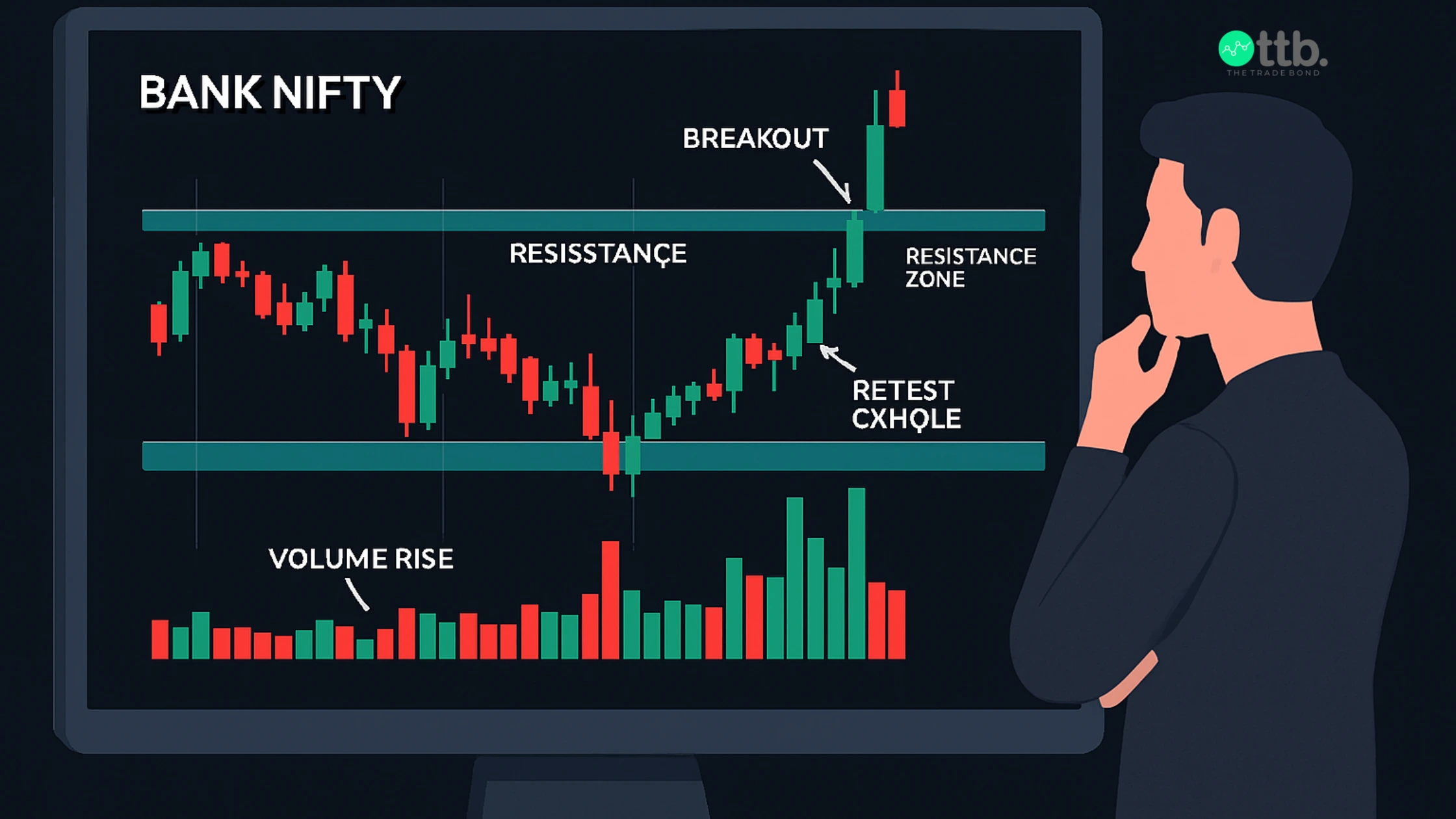
How to Trade Bank Nifty Breakouts Without Getting Trapped
Bank Nifty breakouts attract intraday traders because the index reacts quickly when the market shifts. These sharp movements create many opportunities, but they also increase the possibility of getting caught in false breakouts. At The Trade Bond, we look at how to trade Bank Nifty breakouts by focusing on structure, context, and disciplined decision-making. When you understand the levels, momentum, and overall environment, you respond to the market with more clarity. This approach supports your daily preparation, whether you track Bank Nifty intraday trading or explore Bank Nifty tips today and practical Nifty tips for guided learning.
What Makes Bank Nifty Breakouts Different From Other Indices?
Bank Nifty reacts more sharply to liquidity shifts, interest-rate expectations, and banking sector sentiment. Because the Bank Nifty index carries high weightage in Nifty, and any swift movement in a few major banking stocks can trigger breakout-like candles. This means Bank Nifty breakouts look stronger than they are.
Unlike broader indices, Bank Nifty tends to show:
- Faster wick formations
- Wider candles during news events
- Quick reversals due to institutional order flow
These characteristics make it important to read structure and volume carefully before placing Bank Nifty trades.
Key Market Conditions to Confirm Before Trading Bank Nifty Breakouts
Bank Nifty breakouts work better when the market conditions support expansion. Before entering, you must check with:
Check the overall trend:
A breakout against the trend usually fades out.
Study volume expansion:
Without solid volume, the price may fail to hold above or below the zone.
Look at nearby obstacles:
Previous swing highs, lows, and consolidation ranges may impact continuation.
Review sentiment:
RBI updates, banking results, global cues, and pre-market gaps influence intraday direction.
If you want detailed cross-checking techniques, refer to our page on Research Techniques in Intraday Bank Nifty & Nifty.
Common Reasons Traders Get Trapped During Bank Nifty Breakouts
Many intraday traders fall into traps during Bank Nifty breakouts because:
- They enter too early, before the candle closes.
- By ignoring larger timeframes and jumping in based on small movements.
- They follow breakout candles near strong supply or demand zones.
- Unable to manage risk when volatility expands.
Sometimes the market also creates sudden spikes, attracting traders and reversing immediately after. You can learn more about such mistakes on our blog pages like avoid common intraday trading mistakes in Bank Nifty for more information.
How to Trade Bank Nifty Breakouts With a Clean, Minimal Trading Plan
A simple approach towards how to trade Bank Nifty breakouts creates better clarity:
Mark the breakout zone:
Use pre-market highs/lows or the previous day’s range.
Wait for confirmation:
Allow the breakout candle to close clearly beyond the level.
Check volume:
Volume should support the move.
Use a logical stop-loss:
Place it on the other side of the structure, not on the random tips.
Plan your exit:
Decide how you will scale out if the breakout sustains.
This clean structure helps traders approach Intraday Bank Nifty intraday trading with more confidence and less confusion.
How to Trade Bank Nifty Breakouts Without Falling for Fake Moves
Fake moves occur when the price just touches the level and reverses quickly. To reduce exposure:
- Avoid entering on the first breakout candle of the day.
- Watch for retests; many valid moves come after a retest.
- Avoid trading during uncertain periods such as major announcements.
- Keep an eye on relative strength with Nifty. If both align, the breakout has more stability.
Although, if you follow or study Nifty option tips, these alignment principles work there as well.
Safe Scalping Tips for Fast Bank Nifty Breakout Movements
Scalping Bank Nifty breakout candles require awareness:
- Use 1-minute and 3-minute charts together for better structure clarity.
- Avoid taking trades during sideways markets.
- Exit partially whenever the candle expands beyond its usual size.
- Avoid revenge or rushed entries after a losing trade.
For guidance on structured services, you might also explore our blog pages for Bank Nifty tips provider for more information about Bank Nifty options.
Psychological Traps Traders Face During Bank Nifty Breakouts
Many traders experience such traps during Bank Nifty breakouts:
- Fear of missing out when a candle moves fast
- Overconfidence after a quick early gain
- Impulse entries without waiting for patterns
- Hesitation to exit when price slows down
Being aware of these emotions helps refine discipline, especially when you look for Bank Nifty tips for daily decision-making.
The Trade Bond's View
At The Trade Bond, as a stock market advisor, we believe how to trade Bank Nifty breakouts begin with clarity, controlled expectations, and structured decision-making. Breakouts are not about catching every candle, but they’re about identifying the context that supports the move. A disciplined approach with consistent study of trend, volume, and sentiment helps intraday traders navigate Bank Nifty movement with more maturity. When combined with continuous learning and disciplined execution, breakout trading becomes a more streamlined part of your daily routine.
FAQ's
How do I avoid false breakouts in Bank Nifty?
You can avoid early entries, confirm trend direction, and watch for wicks forming near major supply and demand zones.
What conditions improve Bank Nifty breakout reliability?
Clear momentum, stable market sentiment, aligned movement with Nifty, and rising volume improve breakout sustainability.
Why do traders get trapped during Bank Nifty breakouts?
Traders often react too quickly, enter without confirmation, or ignore nearby obstacles such as previous swing points.