
Common Stock Market Investment Mistakes Beginners Should Avoid

Quick Answer: Beginners investors should stay away from investing without researching and following stock tips blindly, making quick profits, neglecting risks and diversification, making emotional decisions, and focusing on stock prices alone. An intelligent and well-researched decision-making process will enable you to make better decisions.
Investing in the stock market is one of the best ways to earn money and reach your financial objectives. However, most novices plunge into trading without any idea about the nature of stocks, their risks and evaluation techniques.
Mistakes like taking advice from strangers, aiming for instant profit or making decisions based on your mood can have a serious impact on your earnings.
Fortunately, all of the aforementioned mistakes are absolutely preventable. All you need to do is do some research and have discipline. Start with stock market basics, learn about the company, determine your goals, decide on your level of risk, and use only reliable information sources before you start investing.
What you should not do is equally important as what you should do. And that is precisely what this blog is going to help you with. Let’s get started!
Top 6 Common Stock Market Investment Mistakes Beginners Should Avoid
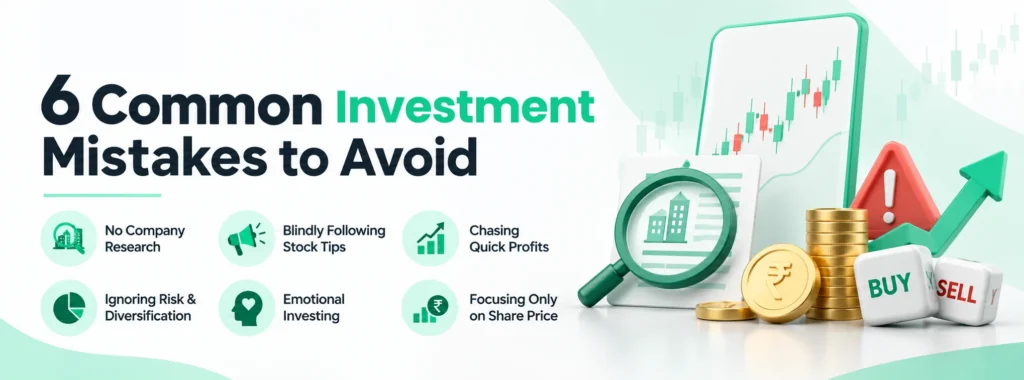
Mistakes will be made by all beginners in the stock market – that is perfectly natural. However, some of these mistakes not only make you lose money, but can also make you lose time, confidence, and even your whole investment. The positive thing is that most of these mistakes are quite common and quite avoidable. Let’s look at them one by one.
1. Investing Without Researching the Company
One of the most common blunders of novice investors is investing in stocks without knowing what lies behind them.
The price of the shares is not sufficient evidence of the health and suitability of the company for you. A proper stock market analysis should consider the following factors before investing:
- Source of earning of the company
- Trends in revenue and profitability
- Leverage
- Cash flows
- Management and corporate governance
- Industry and competitive position
- Future growth prospects
Studying annual reports, financial statements, information from the stock exchange and other sources will help you learn about the company correctly before investing.
SEBI also recommends doing research before investment.
Key lesson: Do not buy a stock just because someone recommended it or its price went up recently. Understand the business first.
2. Following Stock Tips and Market Rumours Blindly
There are many stock tips available on social media sites, in online forums and even through messages on various communication groups. However, all stock tips are not research-based.
Uninformed investors are more susceptible to tips which mention rapid appreciation of certain stocks. Acting on such tips without verifying the information can put you at risk.
Important Fact: SEBI’s Investor Survey 2025 found that 62% of surveyed investors made some investment decisions based on financial influencer recommendations. Nearly 59% rely on friends, family and colleagues for information about market products. This highlights the importance of checking and verifying investment information before making any investment decision.
Always check information through reliable sources and understand why an investment does or does not fit your goals.
Key lesson: Treat unsolicited tips and rumours as something to verify — not as instructions to buy or sell.
3. Chasing Quick Profits
The dream of making quick money pushes many beginners into decisions that do not match their actual goals. When a stock rises fast, it creates a fear of missing out. When it falls suddenly, panic selling kicks in. Both reactions lead to decisions driven by emotions rather than long-term thinking.
Long-term investing needs patience, especially when researching best long term stocks. Stock prices will go up and down, and a company can be fundamentally strong even while its stock is temporarily falling.
Before investing, set a clear investment horizon and accept that returns are never guaranteed. SEBI also states that past performance does not guarantee future returns and recommends considering your goals, investment horizon and risk appetite before investing.
Key lesson: Do not confuse short-term price movement with long-term investment potential.
4. Ignoring Risk and Diversification
Stocks carry market risk and individual prices can swing a lot. Many beginners put too much money into one company, sector or theme simply because they strongly believe in it.
This increases the damage if that one investment performs badly. Spreading your investments across different options can help reduce concentration risk — though it cannot completely eliminate market losses.
Important Fact: SEBI explains that diversification can reduce the negative impact of one poor investment but cannot eliminate market wide risks. This is why diversification should always be considered alongside your financial goals, investment horizon and risk tolerance.
Key lesson: Understand the risks of each investment and never put your entire portfolio behind a single stock or idea.
5. Making Emotional Investment Decisions
Fear, greed, excitement and panic — all of these can push you into bad investment decisions, especially when markets are moving sharply.
For example, you might buy after a strong price rally fearing you will miss out, then sell during a market dip fearing further losses. Reacting like this repeatedly makes it very hard to stick to any consistent investment strategy.
A better approach is to set clear investment goals, understand why you are investing in a particular stock, and only revisit that decision when something significant actually changes.
SEBI’s investor guidance also encourages investors to research properly, diversify and maintain a long-term investment mindset.
Key lesson: Make decisions based on research and your investment plan — not based on every market movement.
6. Focusing Only on Share Price
Many beginners think a low priced stock is automatically cheaper or has more room to grow than a high priced one. That is not how it works. A ₹50 stock is not necessarily more affordable in valuation terms than a ₹1,000 stock. Share price alone tells you nothing about whether a company is actually good value.
Look at earnings, profitability, growth prospects, market capitalisation, valuation ratios, debt and overall business quality instead. And never treat a stock’s past price performance as a promise of future returns.
Key lesson: Judge a stock by its fundamentals and valuation — not by its price per share.
How Can Beginners Build Better Investment Habits?
Avoiding mistakes becomes much easier when you follow a simple structured approach:
- Define your financial goals and investment horizon
- Understand your risk tolerance
- Research a company before investing
- Use reliable and official sources of information
- Never act on unverified tips or rumours
- Diversify appropriately
- Keep emotions out of short-term market movements
- Review investments only when the business or investment thesis actually changes
The goal is not to predict every market movement. It is to build a disciplined process for making informed decisions.
Final Thoughts
Stock market investing needs research, patience and a clear understanding of risk. Beginners can avoid most common mistakes by studying companies carefully, verifying information before investing, avoiding emotional decisions, maintaining proper diversification and looking beyond just the share price.
There is no guaranteed way to avoid all losses. But making informed decisions that match your financial goals, investment horizon and risk tolerance puts you in a much better position. Using reliable sources and building a disciplined investment process is the smartest way for beginners to approach the market.
When things feel too complex or confusing, professional investment guidance can always help you take a more structured and research based approach.
Looking for professional guidance on your investment journey? Connect with The Trade Bond for research based investment guidance tailored to your financial goals and risk profile.
Frequently Asked Questions
What is the biggest mistake beginners make in the stock market?
Investing without properly researching the company. Understanding the business, financial performance, risks and valuation helps you make far better decisions.
Should beginners follow stock market tips?
No. Never blindly follow stock tips or market rumours. Base your decisions on reliable information, independent research, your financial goals and a clear understanding of risk.
Why is diversification important in stock market investing?
Diversification reduces concentration risk by spreading investments across different companies, sectors or asset classes. But it does not completely eliminate the possibility of losses.
How can beginners avoid emotional investing?
Set clear investment goals, define your investment horizon, always research before investing and avoid reacting impulsively to short-term market movements.
Is a low-priced stock a better investment?
Not necessarily. Share price alone does not tell you if a stock is cheap or expensive. Always evaluate the company’s valuation, earnings, financial position, growth prospects and business fundamentals.