
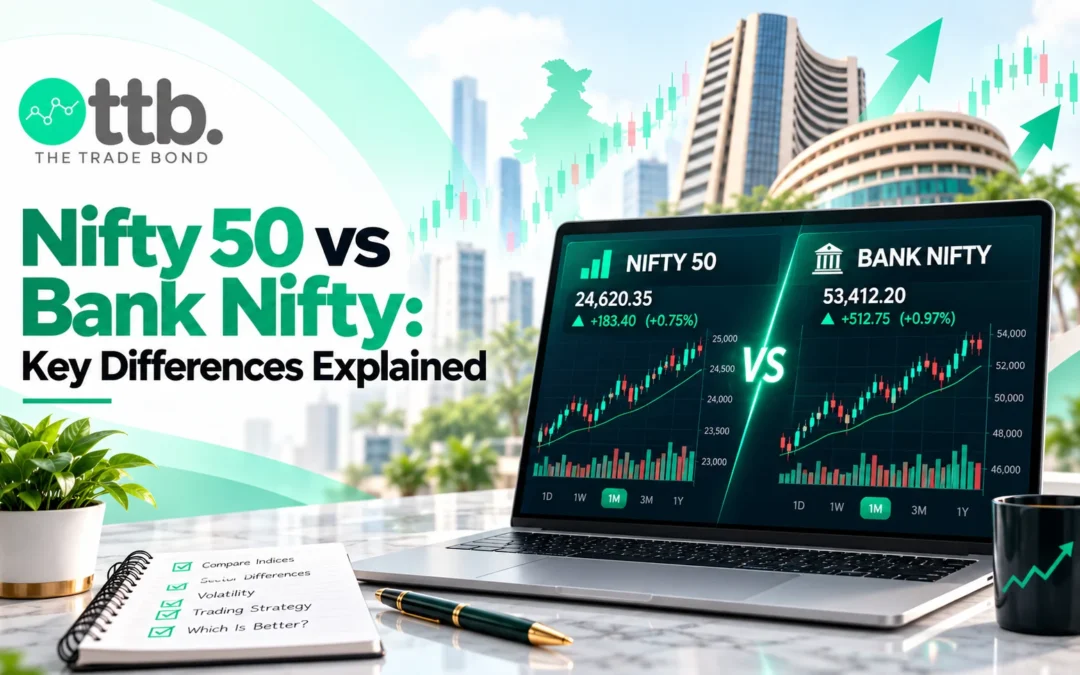
Quick Answer: Nifty vs Bank Nifty - in simple words: Nifty 50 tracks 50 large companies across 13+ sectors and gives you a broad view of the market. Bank Nifty tracks only 12 banking stocks and shows how India's banking sector is performing. Nifty 50 is better for long-term investing while Bank Nifty is more popular for intraday trading and options.
Did you know that almost 90% of retail traders end up losing money from options trading? It's official SEBI statistics that proves this point. And a considerable percentage of this loss is incurred particularly through Bank Nifty options, where the volatility is high, premiums erode rapidly, and a single wrong choice costs you everything you have made in a day.
Bank Nifty trading is very attractive to everyone. We know that. The high volatility, rapid gains, and excitement make everybody fall for it instantly. But without the proper tips for Bank Nifty options trading, all this turns out to be nothing but disappointment. Before exploring these seven tips, beginners should understand the stock market basics and how options work. Let’s get started!
What Is Bank Nifty Option Trading?
Bank Nifty is an index that tracks the performance of India's top 12 banking stocks listed on NSE. These include HDFC Bank, ICICI Bank, SBI, Axis Bank, Kotak Mahindra Bank, Bank of Baroda, Union Bank, Canara Bank, PNB, Federal Bank, Yes Bank, and IndusInd Bank.
When you trade Bank Nifty options, you are not buying any single stock. You are trading contracts based on the overall movement of this banking index. Each Bank Nifty option contract has a standard lot size of 30 units. This means even a small move of 10 points in Bank Nifty can give you a profit or loss. That is why understanding the basics before jumping in is so important. Let’s explore these top 7 tips for beginners.
Top 7 Bank Nifty Option Trading Tips for Beginners
Beginners can approach Bank Nifty options trading more carefully by understanding market movements, managing risk, and following a disciplined strategy. These seven practical tips will help you make informed trading decisions, avoid common mistakes, and build better trading habits.
1. Master Risk Management With Strict Stop-Losses
This is the single most important bank nifty option trading tip any expert will ever give you. Before thinking about profits, think about how much you can afford to lose. Most beginners skip this step - and that is exactly why they blow up their accounts within the first few weeks.
The Golden Rule - System Orders vs Mental Stop-Losses
Always place your stop-loss as a system order the moment you enter a trade. Never rely on mental stop-losses in Bank Nifty. The market moves 200-300 points in minutes. By the time you decide to exit manually, your loss is already doubled.
Risk-to-Reward Ratio – The 1:2 Rule
Always aim to risk 1% of your trading capital to target a potential profit of 2% per trade. For example, if your planned risk is ₹5,000, target a potential profit of ₹10,000, maintaining a 1:2 risk-to-reward ratio. Always adjust your position size and stop-loss to manage risk effectively.
2. Understand Option Buying and Its Risks
The second most important bank nifty option tips for beginners is to fully understand what option buying actually means before putting real money at risk. Many beginners jump into options thinking it is easy money. It is not.
Defined Risk and Premium Loss
When you buy an option, your maximum loss is capped at the premium you paid. For example, if you buy a Bank Nifty call option at a ₹100 premium, your total maximum loss is ₹100 x 15 = ₹3,000 per lot (since the standard lot size is 30). The risk is defined, but remember: most out-of-the-money options expire worthless because time decay (Theta) eats your premium daily.
Why Beginners Should Avoid Naked Option Selling
Naked option selling requires massive margin money-often ₹1.5 lakh to ₹2 lakh per lot-and carries unlimited risk. One bad market spike can wipe out months of profits. As a beginner, stay away from naked selling completely.
New SEBI Reality - Monthly Only Expiries
Under recent SEBI guidelines, stock exchanges can only offer weekly expiry contracts on a single benchmark index. Because the NSE selected the Nifty 50 index for weekly expiries, Bank Nifty contracts have transitioned to a monthly expiry cycle. For a beginner, this is actually an advantage: it removes the noise of weekly expiry trading and gives your directional setups more time to play out.
3. Use Limit Orders and Understand Market Orders
Here is a bank nifty option trading tip that most beginners learn the hard way - always use limit orders in Bank Nifty. Never use market orders, especially during high volatility periods.
The Trap - Slippage and Wide Spreads
During high volatility - like RBI policy announcements or big market news - the bid-ask spread in Bank Nifty options widens massively. If you place a market order, you might buy at ₹150 when you expected ₹120. That difference is called slippage and it silently kills your profits.
The Fix - Check Liquidity and Execution Prices
Always check the bid price and ask price before entering. You can also study intraday trading tips using price action to learn how price movements and chart patterns may support your trading decisions. Place a limit order at the price you are comfortable with. If the market does not come to your price - let the trade go. There will always be another opportunity tomorrow.
4. Focus on Liquid Contracts and ATM Options
One of the most practical bank nifty option tips for beginners is to always trade liquid contracts. Illiquid options can trap you - you enter easily but cannot exit when you want to.
What Makes an Option Liquid?
Two things make an option liquid - Volume and Open Interest. High volume means many people are actively trading that option. High open interest means many contracts are currently open. Always look for options with high OI and volume before entering any trade on NSE.
Why Compare ATM, ITM, and OTM Options?
ATM means At The Money - the strike price closest to the current Bank Nifty level. ITM means In The Money - already has value. OTM means Out of The Money - no intrinsic value yet. Many beginners chase OTM options because they are cheap - like ₹5 or ₹10. But these are lottery tickets. They expire worthless 90% of the time. As a beginner always stick to ATM options only.
5. Monitor Major Bank Nifty Stocks and Economic Events
This bank nifty option trading tip is something most beginners completely ignore. They only watch Bank Nifty chart but never track the individual bank stocks that actually move it.
Track the Index Heavyweights
HDFC Bank, ICICI Bank, and SBI together drive approximately 60% of Bank Nifty's total movement. If these three stocks are falling - Bank Nifty will fall. Simple as that. Every morning before trading, check how these three stocks are opening and moving. Traders who study opening price movements can also explore the smart bank nifty opening range breakout strategy to understand how an opening range breakout setup works.
Understand Event-Related Volatility
Three things spike Bank Nifty volatility massively - RBI Policy announcements, Corporate Earnings results, and India VIX levels. When India VIX is above 20 - option premiums are very expensive and unpredictable. As a beginner, avoid trading on high-impact event days until you have enough experience.
6. Learn to Read the Bank Nifty Option Chain
Every serious beginner must learn this bank nifty option tips skill before going live. The option chain is available for free on the NSE website and helps traders assess market sentiment. Learning to read option chain data for bank nifty can help beginners interpret open interest, strike prices and potential support and resistance levels.
In the option chain - Calls are on the left side and Puts are on the right side. LTP means Last Traded Price - the most recent price at which that option was traded. The most important thing to understand is - wherever you see heavy Put Open Interest, that level acts as strong Support. And wherever you see heavy Call Open Interest, that level acts as strong Resistance. This single skill can dramatically improve your entry and exit decisions in Bank Nifty trading.
7. Practise With Paper Trading Before Going Live
The last but one of the most valuable bank nifty option trading tip for every beginner is - do not trade with real money until you have practiced enough. Paper trading means you track trades without actually putting real money at risk.
You can do this easily by following NSE live data on nseindia.com and writing down your entry, exit, stop-loss and target every day in a notebook. Do this for at least 30 trading sessions. Once you see consistency in your paper trades - then consider going live with small capital. This one habit alone can save you from losing lakhs of rupees as a beginner.
Common Bank Nifty Option Trading Mistakes to Avoid
Even with the best bank nifty option tips, beginners can make costly errors, so understanding common stock market investment mistakes is equally important.
- Overtrading - Taking 5-10 trades a day hoping one will work
- Revenge trading - Doubling down after a loss to recover quickly
- Holding dying options - Keeping losing options hoping for a miracle recovery
- Ignoring stop-loss - Letting small losses turn into account-destroying losses
- Chasing OTM options - Buying cheap ₹5-10 options that expire worthless
- Trading on event days - Taking positions during RBI policy or earnings without experience
- Following random tips - Trading based on unverified WhatsApp or Telegram tips
Understanding and avoiding common intraday trading mistakes is often more important than finding the perfect bank nifty option trading tip. Discipline and consistent risk management matter over the long term.
Make Smarter Market Decisions with The Trade Bond
Nowt sure whether Nifty 50 or Bank Nifty aligns better with your financial goals and risk appetite? Get expert guidance from The Trade Bond to understand market trends, evaluate trading opportunities, and make informed decisions with a well-defined strategy. Whether you're a beginner or an experienced trader, take the next step toward more disciplined trading and investing.
Get Expert Trading GuidanceConclusion
Both Nifty 50 and Nifty Bank are powerful indices - but they serve completely different purposes. Nifty 50 is built for the investor who wants steady, diversified, long-term growth. Bank Nifty is built for the trader who wants fast moves, high volatility and bigger opportunities in a single session.
If you are just starting out - stick with Nifty 50. Learn the market, understand how it moves, and build your confidence first. Once you are comfortable, Bank Nifty will always be there for you.
And if you ever need expert guidance on which index suits your trading style and risk profile - The Trade Bond's SEBI-registered advisors are always here to help you make the right decision with confidence.
Frequently Asked Questions
Q1. Which is better for beginners - Nifty 50 or Bank Nifty?x
Nifty 50 is clearly better for beginners. It is more stable, diversified across 13+ sectors and less volatile. Bank Nifty moves 400–600 points daily and requires strong market knowledge and experience. If you are new to trading or investing, always start with Nifty 50 first before moving to Bank Nifty.
Q2. Why is Bank Nifty more volatile than Nifty 50?
Bank Nifty tracks only 12 banking stocks - all from one sector. When RBI changes interest rates or a big bank like HDFC Bank posts weak results, the entire index reacts sharply. Nifty 50 spreads across 13+ sectors so no single event can shake it as badly as Bank Nifty gets shaken.
Q3. Why do most beginners lose money in Bank Nifty options?
Yes absolutely. Many traders and investors use both - they invest in Nifty 50 index funds for long-term wealth creation and trade Bank Nifty options for short-term income. Just make sure your risk management is in place before trading Bank Nifty as it is significantly more volatile.
Q4. What moves Bank Nifty the most?
RBI monetary policy decisions are the biggest mover of Bank Nifty. Interest rate changes, credit growth data, quarterly results of HDFC Bank and ICICI Bank, and global banking sector news can all cause sharp moves of 500–1,000+ points in Bank Nifty within a single trading session.
Q5. What is the long-term return difference between Nifty 50 and Bank Nifty?
Nifty 50 has delivered approximately 11–13% CAGR since its launch in 1996. Bank Nifty has delivered 14–16% CAGR but with much higher volatility and bigger drawdowns along the way. Bank Nifty gives higher returns but also carries significantly higher risk compared to the diversified Nifty 50 index.