
Intraday Trading Tips and Strategies for Beginners
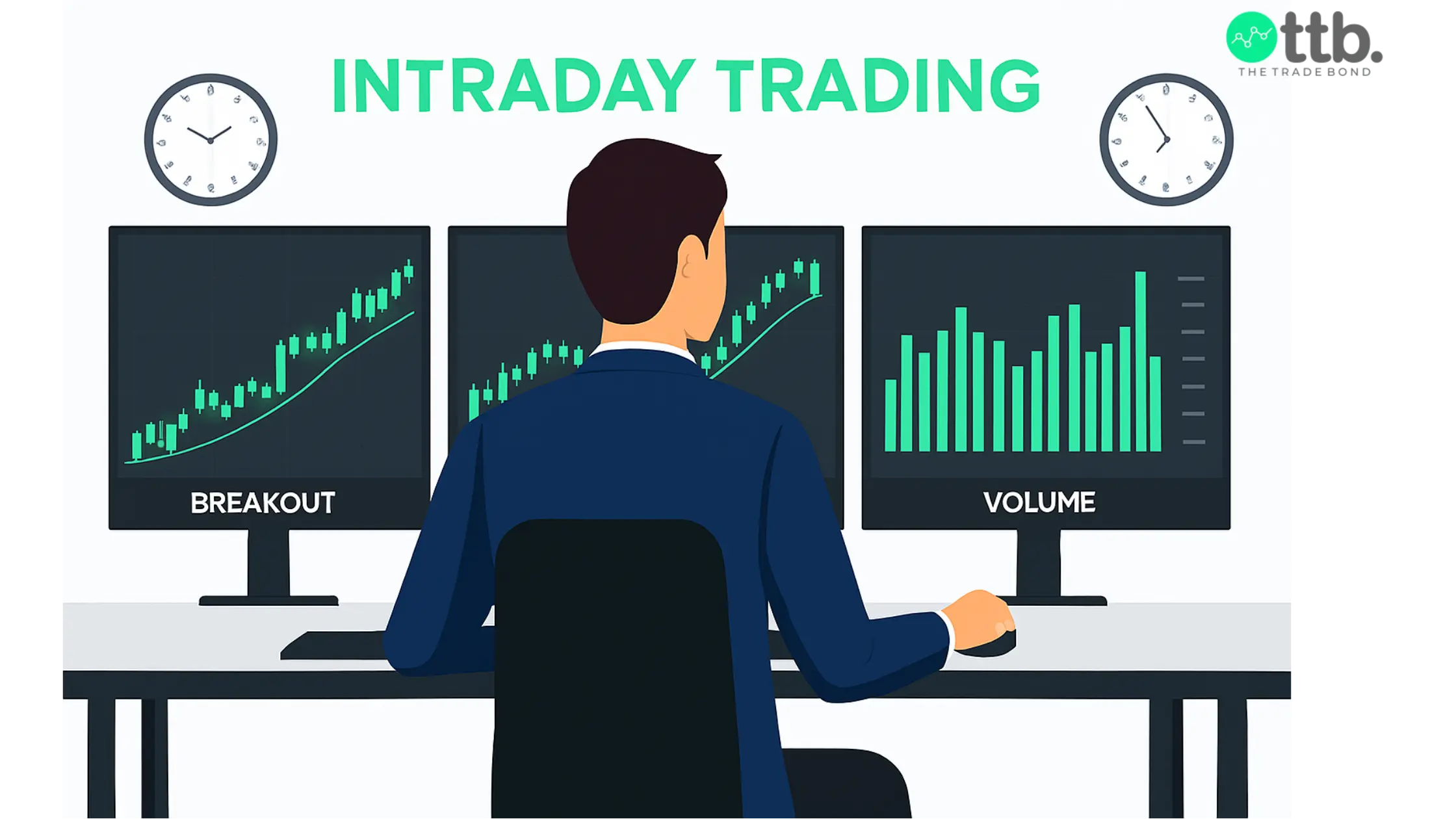
Learning about Intraday Trading Strategies
Intraday trading tips and strategies are very useful for traders who buy and sell stocks within the same day. Usually this type of trading needs quick decision-making, proper planning, and strong risk control. Unlike delivery trading, where positions are held overnight. Intraday traders must close their trades before the market closes. In this blog, you will know about the process of stock selection and strategies used by traders. And also about common mistakes to avoid.
Knowing about Intraday Trading Tips & Tricks
With the help of a disciplined approach, you can handle these quick-moving markets. Below are some of the valuable tips and tricks:
Prepare your trading plan: Plan your entry, exit, and stop-loss levels in advance. A clear trading plan helps in making informed decisions and helps you avoid impulsive decisions.
Follow the market trend: Analyzing the market trends is a very important step before taking any trade, especially for beginners. Following the market trend helps in marking a trade.
Selecting liquid stocks:
Mainly focus on actively traded shares with high volumes for easy entries and exits.
Hold the price of entry and exit:
Before entering any trade, clearly define your target and stop-loss.
Set a stop-loss:
With the help of a stop-loss, you can protect your capital from unexpected market moves.
Book profit when the target is reached:
Once you reach the target, exit your trade to avoid emotional decisions.
Close all open positions:
To avoid overnight risks, close all your open positions before the market closes.
Trade with a calm mind: Fear and greed can cloud your judgement, so trade calmly and trade according to your planned strategy.
Skip the dead-end trades: In intraday investing, staying in trades that are not performing as expected can backfire. As a beginner trader, avoid averaging into losing trades.
Select the right platform:
A right trading platform that is reliable and fast, and that supports better chart analysis and trade execution.
By following these Intraday Trading Tips and Strategies, you can trade more confidently and make informed decisions. Visit our dedicated service page for intraday trading tips to get practical guidance from our trusted SEBI-registered advisor.
How to Choose Stocks for Intraday Trading?
Stock selection is one of the most important steps in successful intraday trading strategies. Usually traders pick stocks that have higher liquidity, as they allow easy entries and exits during market hours. Therefore, monitoring overall market and sectoral indices like Nifty 50 and Bank Nifty. Therefore, it helps to identify stocks that move in line with broader trends. Along with this, news-driven stocks that react to quarterly earnings, policy announcements, or global events are often preferred for intraday trading. Therefore, another useful step is marking support and resistance zones from the previous days. As these levels guide possible breakouts or reversals. You can explore more about market research in our Bank Nifty and Nifty research techniques blog.
Most used Intraday Trading Strategies
Not every trader will follow the same techniques. They follow different techniques based on market conditions. These are the most commonly used strategies:
Breakout strategy:
You can enter trades when prices cross support or resistance levels with strong volume.
Pullback strategy:
This strategy helps to trade in the direction of the trend after short-term corrections.
Scalping strategy:
By using this strategy, you can make multiple trades for small price movements during the day.
Momentum strategy:
Trade on sudden price moves supported by high volumes.
Connect with our intraday trading calls provider in India to know more information about intraday trading insights.
Additional Factors for Intraday Trading Success
Apart from stock selection, strategies, and risk control, there are some additional factors that make intraday trading more effective. Most of the traders depend on shorter time frames, such as 5-minute, 15-minute, or hourly charts, to find entry and exit levels with greater clarity. And tools like VWAP and volume confirmation also play an important role. Therefore, price breakouts or reversals become stronger when they are backed by trading volumes. Another practice is setting a daily stop-loss limit. This can help to avoid emotional decisions. Finally, selecting a trading platform with advanced features and fast execution will help a lot. Although it ensures technical analysis and trade placement happen during volatile market hours.
Along with all these strategies, there are two more important strategies that help beginner traders – SL Trail Strategy and Part Profit Booking Strategy. These two strategies are most useful for traders who are new to the market.
Now, let us learn about these strategies:
SL Trail: SL trail stands for stop loss trailing. It is a popular strategy commonly used by traders. It helps in managing risk in your positions. SL trail strategy helps in minimising your losses in positions and protects your capital in the market. So basically, it is a flexible stop order that moves up with the stock when it’s going your way, helping protect your gains, but it won’t move back if the price starts falling.
How It Works:
First of all, set your stop loss. Decide how much you are willing to lose if the market goes against you before even entering a trade. Decide how closely you want your stop loss to follow the price. Continue to modify your stop loss near the cost or a few points below the cost as the trade moves up. So even if the market sentiments are against you, by using this strategy, you can protect your capital at the earliest and avoid losing much of your capital in the market. This strategy takes the stress out of trading by keeping emotions like fear or greed in check. It lets you focus on spotting new opportunities while knowing that your current trade is being managed safely. In short, a trailing stop-loss is a simple way to lock in profits, minimize losses, and trade with more confidence, especially when the market is moving fast.
Example:
Let’s say you buy a stock at the price of 100 and you have decided your target will be 60 points, which is 160, and your stop loss will be 30 points, which is 70. Now, once you enter the trade and the trade starts going up, continue to monitor the trade and modify your stop loss to fewer points or nearby cost as the trade moves. In this way, even if the trade goes in reverse, you may not end up losing much of your invested capital.
Therefore, following the stop loss strategy is very helpful for beginner traders because it removes lots of stress from trading. It makes it easier to protect profits and limit losses without the hassle of constant monitoring. New traders often struggle with emotional decisions—like selling too early out of fear or holding on too long out of greed. A trailing stop-loss helps control these emotions by moving automatically with the price in your favor and locking in gains if the market turns.
Part Profit Booking Strategy:
Just like the SL trail strategy, the part profit booking strategy is also most important for beginners, and you can use both at the same time in your position. It will not only minimize your losses but will also increase the overall probability of gaining profits in the market. Part Profit Booking is a simple way to take some profits while still staying in the trade. Instead of selling your entire position at once, you sell a portion when the price reaches a target and keep the rest invested in case the price keeps going in your favor. This helps you to book some profits early and stay in the trade for bigger opportunities. With SL modifications and booking part of the profits, you can book safe gains even if the market doesn’t go in your favor.
How It Works:
For part profit booking, first of all, decide your target. Once you fix your actual target, continue to monitor the trade and analyze market momentum. After that, divide your target into two parts. At first, book some quantity according to your risk appetite and hold the remaining quantity for the actual target. Use the SL trail strategy with it. In this way, you can book some profit even if the trade doesn’t go as planned. You can also use this strategy when you are aiming for a higher target.
Example:
Let’s say you buy a trade at the price of 120. Your fixed target is 50 points, which is 170, and SL will be 25 points, which is 95. Now, once the trade starts moving in an upward direction and after analyzing, you feel that the actual target won’t get achieved, you can book at half points of the actual target, e.g., actual target 170, half 135. So you can book a few quantities according to your risk appetite.
Hence, just by using these 2 strategies, you can improve more than 70% of your trading style and follow the path of becoming a disciplined trader. For more strategies and guidance on how to invest in the market as a beginner, contact The Trade Bond, a SEBI-registered advisory and a one-stop solution for all your trading-related queries. trading-related queries.
A part of intraday trading, if you’re willing to know about more segments like Bank Nifty tips, Nifty option tips, and Option trading tips. Contact our SEBI-registered investment advisor for more details.
Most Common Mistakes to Avoid in Intraday Trading
Even with the best intraday trading strategy, many market participants face losses due to some common mistakes. Overtrading is one of the most common mistakes made by traders. Hence, chasing multiple trades in a day can increase costs. Another mistake is ignoring position sizing. Risking more than 1-2% of your capital on a single trade can result in major losses. Similarly, traders will be exposed to sudden market fluctuations by ignoring stop-loss. Also, especially emotional trading after a loss leads to more losses.
Although brokerage costs can also be considered because they reduce intraday gains. Timing also matters a lot in intraday trading. Beginners often find it safer to trade when price action is more stable. Therefore, if you want to compare different trading styles, read our guide on intraday vs delivery trading.
Conclusion
Intraday trading tips and strategies offer a proper approach to trading the market within a single day. By selecting liquid stocks, creating a plan, applying the right strategies, and avoiding common mistakes, you can trade freely. Also, you can navigate market volatility more effectively. Check out our pages on intraday tips for today NSE and stock for today intraday for daily opportunities. Although at The Trade Bond we offer different services such as Equity intraday, Short-term trading, Long-term trading, Swing trading tips as well.
Therefore, intraday trading is all about preparation, patience, and discipline. Update your approach, track your performance, and build confidence with a step-by-step approach. Hence, intraday trading tips and strategies can become a strong foundation for your journey.
FAQ's
Can I trade during the first hour of the market?
In intraday trading, the most volatile period is the opening hour because it has sharp price swings. So, new traders need to wait until 10:15 a.m. to trade. You can trade when the market stabilizes.
How much capital do I need to start intraday trading?
You can start with less capital and trade with money you can afford to lose. So, risking 1-2% of your capital on a single trade is considered safe.
Does volume matter in intraday trading?
Yes, volume is a very important factor. Although breakouts are supported by high volumes, which are considered more reliable than moves without volume support.